
Demand Generation vs. Lead Generation: Why You Need Both,But Not the Way You Think
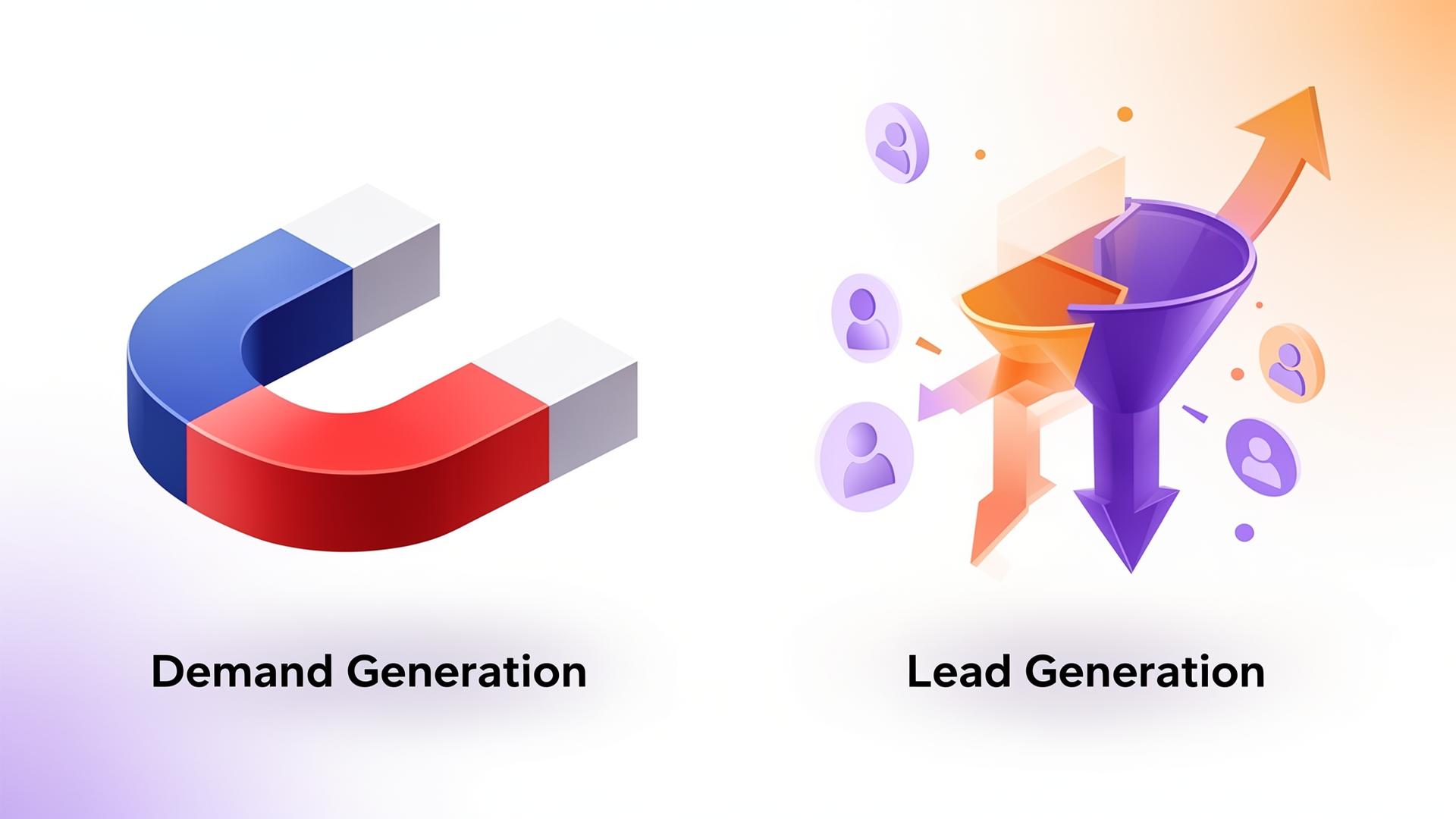
and are often confused or pitted against each other. Learn why the future lies in integrated revenue marketing and how to strategically interlock both disciplines.
The False Debate: Demand Gen vs. Lead Gen
teams often harbor a quiet conflict: advocates insist that "gating content is dead" and you must create demand first. purists counter that without measurable leads, no pipeline forecast is possible. The truth? Both are right,and both are wrong.
Demand Generation and Lead Generation aren't opposites. They're complementary phases of an integrated revenue marketing system.
The Definitions,Clearly Separated
| Dimension | Demand Generation | Lead Generation |
|---|---|---|
| Goal | Create awareness & demand | Capture contact data & purchase intent |
| Timeframe | Long-term (3-12 months) | Short-term (1-4 weeks) |
| Metrics | Brand awareness, share of voice, engagement | MQLs, SQLs, cost per lead |
| Content | Ungated: podcasts, blogs, social, events | Gated: whitepapers, webinars, demos |
| Funnel Position | Top & middle of funnel | Middle & bottom of funnel |
| Attribution | Hard to measure (dark funnel) | Directly measurable (form fills) |
Why Lead Generation Alone No Longer Works
The MQL Paradox
Most B2B companies optimize for MQLs (Marketing Qualified Leads). The problem: An MQL is someone who downloaded a whitepaper,not someone who wants to buy.
The sobering numbers:
- Only 5-15% of MQLs become SQLs
- Sales ignores 50-70% of all marketing leads
- The average MQL costs €150-300 but generates only €15-30 in pipeline per euro invested
The Buyer Journey Has Changed
Modern B2B buyers complete 70-80% of their purchase decision before speaking to a sales rep. This means:
- They research anonymously (, peer recommendations, communities)
- They consume without filling out forms
- They trust peers more than vendor
- They want to decide when they're ready for sales
> "You can't generate demand by putting forms in front of valuable content. You only generate frustration." – Chris Walker
Why Demand Generation Alone Isn't Enough Either
without -capture mechanisms has a fundamental problem: revenue . If you don't know which accounts your content influenced, you can neither justify budget nor optimize programs.
The Attribution Gap
- Self-Reported Attribution: "How did you hear about us?" captures only 30-40% of the journey
- Multi-Touch Attribution: Captures digital touchpoints but not dark social
- Account-Level Attribution: Shows engagement at account level but not individually
The Integrated Model: Revenue Marketing
The solution is neither pure demand gen nor pure gen,it's an integrated revenue marketing model that strategically interlocks both disciplines.
The Revenue Marketing Pyramid
Layer 1: Brand & Awareness (Demand Gen)
- Thought leadership (ungated)
- Podcast, newsletter, social media presence
- building and event marketing
- SEO & organic content strategy
Layer 2: Engagement & Education (Demand Gen → Lead Gen)
- Interactive content (assessments, calculators)
- Webinars and workshops (light gating)
- Personalized content hubs
- Retargeting based on engagement signals
Layer 3: Conversion & Pipeline (Lead Gen)
- Demo requests and consultation calls
- Case studies and ROI calculators
- Free trials and product-led growth
- Intent-based sales outreach
Layer 4: Expansion & Advocacy (Revenue)
- Customer marketing and upsell campaigns
- Referral programs
- Customer advisory boards
- Co-marketing with customers
Content Strategy in the Integrated Model
The art lies in balancing ungated and gated content:
| Content Type | Format | Gating Strategy |
|---|---|---|
| Thought Leadership | Blog, podcast, social | 100% free |
| Educational | Guides, frameworks | Optional (email for updates) |
| Actionable | Templates, checklists | Light gating (email only) |
| Strategic | ROI reports, benchmarks | Medium gating (name + email + company) |
| Sales-Enabling | Demos, assessments | Full gating (qualification questions) |
Orchestrating Multi-Channel Buyer Journeys
Modern buyers don't move linearly through the . They jump between channels, phases, and touchpoints. The revenue marketing architecture must map this non-linearity:
Channel Mix by Funnel Phase
Awareness: LinkedIn organic, SEO, podcast, PR,
Consideration: , email nurture, webinars, case studies
Decision: Personalized outreach, demos, ROI workshops, references
Expansion: Customer newsletter, exclusive events, advisory board
Signal-Based Orchestration
Instead of rigid nurture sequences, the system responds to real-time signals:
- Website behavior: Pricing page visited → sales alert
- Content consumption: 3+ assets in one week → increase engagement score
- Intent data: Competitor keywords researched → send competitive battlecard
- Social engagement: Post commented → add to personalized sequence
KPIs for Revenue Marketing
Away from , toward revenue-relevant KPIs:
| KPI | What It Measures | Target |
|---|---|---|
| Pipeline Generated | € value of generated pipeline | 3-5× marketing budget |
| Pipeline Velocity | Speed through the | <90 days average |
| Revenue Influenced | % revenue with marketing | >60% |
| CAC Payback | Months until customer acquisition cost is recovered | <12 months |
| Net Revenue Retention | Revenue development with existing customers | >110% |
Implementation Framework
Step 1: Audit the Status Quo
- What percentage of your is gated vs. ungated?
- What's your MQL-to-SQL ?
- Where in the buyer journey are you losing the most prospects?
Step 2: Content Rebalancing
- Ungate the top 20% of your gated
- Develop new demand gen formats (podcast, newsletter)
- Implement progressive profiling instead of hard gates
Step 3: Build Signal Infrastructure
- Integrate intent data provider
- Activate website personalization
- Switch lead scoring to engagement-based models
Step 4: Sales-Marketing Alignment
- Define shared revenue goals
- Establish SLA for lead follow-up
- Introduce weekly revenue reviews
Step 5: Measure and Iterate
- Implement multi-touch attribution
- Add self-reported attribution
- Quarterly business reviews with revenue focus
Conclusion: It's Not About Demand vs. Lead,It's About Revenue
The " vs. " debate is a false dilemma. Organizations that understand both disciplines as complementary parts of a revenue marketing architecture achieve significantly better results than those that choose one side.
The key lies in the right balance: Enough demand gen to create demand. Enough gen to capture that demand. And a revenue marketing framework that orchestrates both.
Want to transform your marketing from lead generation to revenue marketing? Davies Meyer develops an integrated strategy with you that connects demand generation and lead generation into a growth-oriented system.
Loading related terms…
All TermsReady for your next project?
Let's discuss your marketing challenges and develop solutions together.
Get in touchKeep reading
Related posts
 StrategySeptember 13, 20269 min
Marketing strategy in 90 days: The decisions behind growth
Which decision will move growth forward? Six strategic questions connect customer understanding, creative ideas and investment, with a 90-day working plan.
Read article StrategySeptember 11, 20267 min
AI strategy: Think bigger, start with focus
What becomes possible when we combine AI with customer knowledge and clear quality criteria? A starting point from Patrick Collison, translated into practical decisions for digital services.
Read article StrategySeptember 11, 20267 min
Brand differentiation: Why customers choose you
A relevant advantage needs a recognisable brand and an easy path to use. How brand strategy, design and digital applications work together.
Read article
Bekomme solche Insights jede Woche.
Strategische Marketing-Insights für CMOs — kein Fluff, kein Spam.