
Fandom Marketing: How Brands Build Fan Communities Instead of Followers
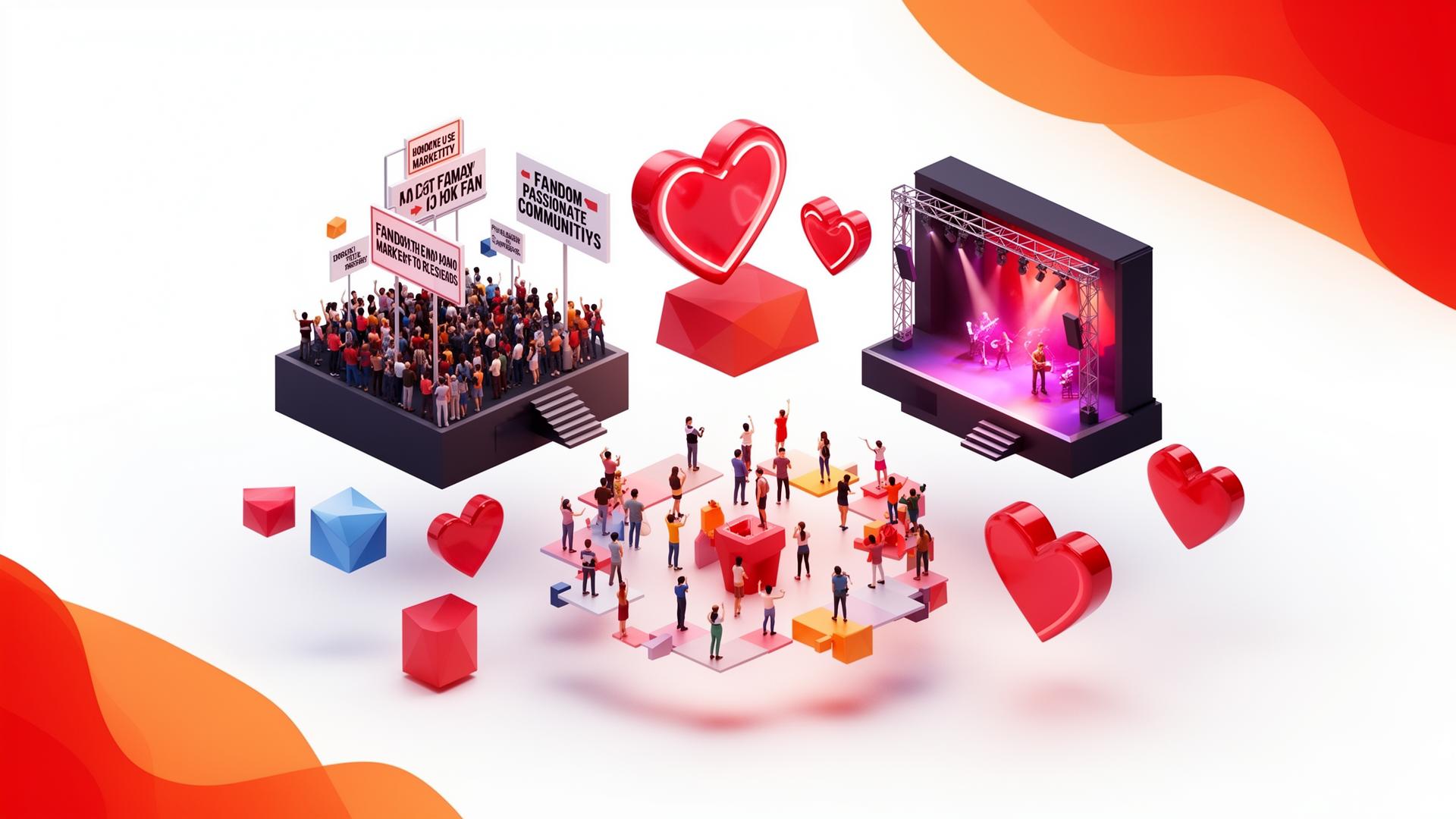
From followers to fans: Why is the most sustainable growth strategy – and what brands can learn from gaming, K-Pop, and D2C brands.
The Follower Problem
10,000 followers on Instagram. 5,000 on LinkedIn. Sounds good – but does it really deliver?
The honest answer: usually not. Followers are a vanity metric. They see your (maybe), but rarely interact and buy even less frequently. Organic on most platforms is below 5%. That means: 95% of your painstakingly built doesn't even see your content.
Fandom Marketing flips the model. Instead of accumulating as many passive followers as possible, it builds a small but passionate community – real fans who actively support, spread, and defend your brand.
What Is Fandom Marketing?
Fandom Marketing transfers the mechanics of fan cultures – from gaming, music, sports, and entertainment – to brand strategies. It's about creating an emotional bond that goes beyond rational product benefits.
The Fandom Pyramid
| Level | Label | Behavior | Share |
|---|---|---|---|
| 5 | Evangelists | Actively spread, defend the brand | 1–3% |
| 4 | Power users | Create their own (UGC) | 5–10% |
| 3 | Active fans | Comment, share, recommend | 15–20% |
| 2 | Engaged followers | Like, save, occasionally interact | 30–40% |
| 1 | Passive followers | Follow but barely interact | 40–50% |
The goal: Move people from Level 1 to Level 5.
What Brands Can Learn from Fan Cultures
Lesson 1: Gaming – Skin in the Game
The gaming industry understood that comes from participation. Players invest not just money but time, creativity, and identity. Fortnite generates billions – not from selling games but through -driven and events.
For brands: Give your community tools to become part of the brand. Co-creation, user-generated content, community challenges.
Lesson 2: K-Pop – The Fan Army Model
BTS and BLACKPINK have shown what's possible when fans organize as an army. The BTS ARMY coordinates streaming sessions, organizes fan events, and dominates social media trends – without instruction from the band.
For brands: Give your fans an identity. A name, shared rituals, exclusive insider references.
Lesson 3: D2C Brands – Community as Distribution Channel
Brands like Glossier, Gymshark, and The Ordinary have built communities that simultaneously handle product development, marketing, and sales. Glossier emerged from a blog with a community that co-developed products.
For brands: Involve your community in product decisions. From color selection to feature prioritization.
Community-Led Growth: The Strategy Behind It
What Is Community-Led Growth (CLG)?
CLG is a growth strategy where the is the primary growth driver – not , not sales teams, but real people speaking for the brand.
The CLG Flywheel
1. Attract: Create a space that draws like-minded people
2. Engage: Provide real value – knowledge, networking, exclusivity
3. Empower: Give members tools and recognition
4. Amplify: Fans carry the message outward
5. Convert: Trust leads to conversions
6. Retain: belonging reduces churn
CLG vs. Traditional Growth
| Dimension | Traditional Growth | Community-Led Growth |
|---|---|---|
| Growth driver | Paid media, sales | Community, word-of-mouth |
| CAC trajectory | Rises with scaling | Decreases with scaling |
| Content production | Internal, expensive | Community-driven, scalable |
| Customer retention | Programmatic | Emotional, identity-building |
| Feedback loop | Slow (surveys) | Real-time (community) |
| Defense | Weak | Strong (fans defend) |
7 Tactics for Successful Fandom Marketing
1. Create Rituals and Traditions
Every strong has rituals. Apple has keynotes, Nintendo has Direct, Spotify has Wrapped. Create recurring moments your community looks forward to.
2. Offer Exclusivity
Not everything for everyone. Exclusive , early access, behind-the-scenes, private channels – exclusivity creates belonging and appreciation.
3. Encourage User-Generated Content
Make it easy and attractive to create about your brand. Templates, challenges, hashtags, features – and above all: appreciation for creators.
4. Make Community Members Visible
Celebrate your community. Highlight individual members, share their stories, give them a stage. People want to be seen.
5. Develop Shared Language
Every community has its own language code. Insider terms, abbreviations, memes – they create identity and belonging.
6. Create Offline Experiences
The strongest communities also exist offline. Meetups, pop-up events, community days – personal encounters deepen digital relationships.
7. Governance and Moderation
Every community needs rules and people who enforce them. Toxic behavior destroys communities faster than anything else.
Community Platforms Compared
| Platform | Strength | Weakness | Ideal for |
|---|---|---|---|
| Discord | Real-time, channels, roles | Learning curve for non-gamers | Tech, gaming, creator |
| Slack | Professional, structured | Costs at large scale | B2B, professional services |
| WhatsApp Communities | High open rate | Limited features | D2C, local brands |
| Circle | Built for communities | Less well-known | Course creators, coaches |
| Authentic, unfiltered | Little control | Niche communities |
Measuring Community-Led Growth
The Right KPIs
Fandom marketing needs different metrics than traditional social media marketing:
- Growth Rate: How fast is the active growing?
- Depth: Not just likes but comments, shares, UGC
- Net Promoter Score (NPS): How likely are members to recommend the brand?
- Community-attributed Revenue: Which revenue is directly attributable to community activities?
- Customer Lifetime Value (CLV): Do community members have a higher CLV?
- Churn Rate: Is churn lower among community members?
Our Recommendation
is not a quick-fix strategy. It requires patience, authenticity, and genuine investment in people – not algorithms.
At Davies Meyer, we help brands transition from follower logic to fandom logic. We develop strategies that don't just generate but drive sustainable growth.
Our approach:
1. Audit: Where does your community stand today? (Or: Does one even exist?)
2. Strategy: Which fandom mechanics fit your brand?
3. Build: Platform selection, community design, first activations
4. Scale: From 100 to 1,000 to 10,000 active members
5. Monetize: Translate community growth into business growth
Conclusion: Followers Are Renters – Fans Are Owners
The most valuable resource in marketing isn't – it's relationship. Followers can be gone tomorrow. Fans stay. They buy, recommend, defend, and co-create.
Don't build an . Build a . Build a fandom.
Loading related terms…
All TermsReady for your next project?
Let's discuss your marketing challenges and develop solutions together.
Get in touchKeep reading
Related posts
 Digital TrendsSeptember 13, 20266 min
Payload & MCP: From product knowledge to reviewed content
The product knowledge exists, but publishing the next page still takes many manual steps. A practical example shows how a CMS, AI and editors can work together.
Read article Digital TrendsJuly 27, 20269 min
Agentic Commerce: What Happens When Agents Buy Instead of People
Checkout is moving into the chat. ChatGPT, Gemini and Copilot compare, decide and buy on behalf of your customers. Here is what that means for product data, feeds, trust signals and your conversion logic.
Read article Digital TrendsJuly 26, 20268 min
Google AI Max and the New Search Monetisation: What Billions of New Queries Mean for Your Paid Search Budget
AI surfaces generate longer, more specific queries — and with them inventory that did not exist before. How to align campaign structure, keyword logic and budget planning.
Read article
Bekomme solche Insights jede Woche.
Strategische Marketing-Insights für CMOs — kein Fluff, kein Spam.