
3D Gaussian Splatting and B2B showrooms: making industrial products understandable
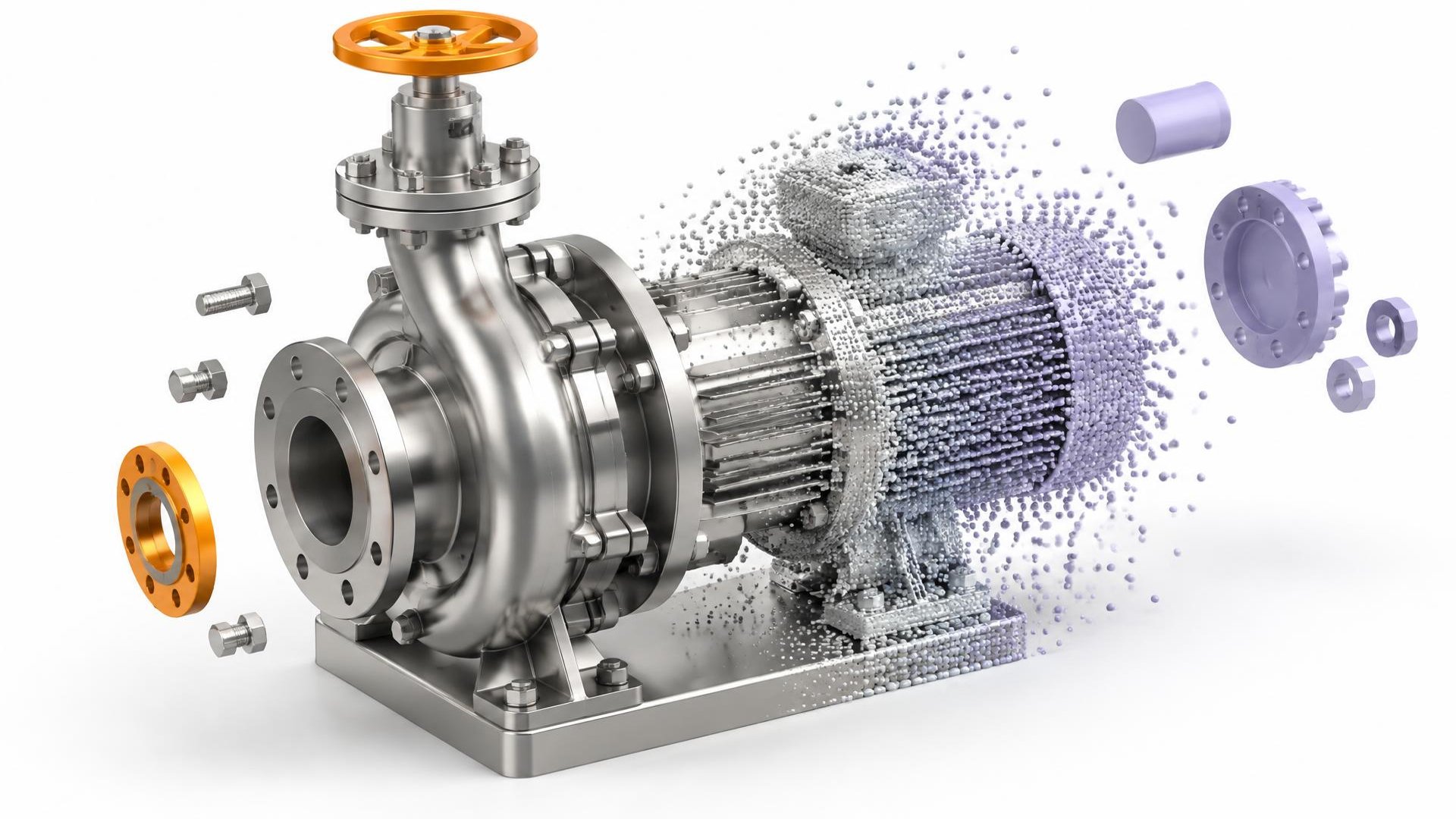
When Gaussian Splatting, CAD and CGI explain industrial products better: buying committees, product accuracy, licences, mobile access and qualified enquiries.
Product presentation should prepare a buying decision
An industrial product is rarely purchased because it looks spectacular on a website. Procurement, engineering, operations and management need different questions answered: Will the equipment fit the available space? How does the process work? Which variants exist? Which information is binding? For leaders, an immersive presentation is valuable when it makes those questions easier to answer and leads to a qualified next step.
The research brief proposes 3D Gaussian Splatting and immersive showrooms. These involve different tools that should not be confused. A visual reconstruction of an existing machine is not the same as a CAD-based model, a functional animation or a digital twin connected to live operating data. The correct choice follows the decision problem, not the novelty of the technology.
This article provides a working framework for industrial businesses. It does not a universal uplift or a proven revenue advantage. Nor do the possible applications described here imply that Davies Meyer has already delivered every method discussed for clients.
What 3D Gaussian Splatting actually does
The paper “3D Gaussian Splatting for Real-Time Radiance Field Rendering” by Kerbl, Kopanas, Leimkühler and Drettakis was published at SIGGRAPH in 2023. The original project page from Inria and the participating researchers describes reconstructing views from captured images. The scene is represented through spatial Gaussian distributions whose position, shape, transparency and colour are optimised for rendering. These elements are projected onto the image plane when rendered.
For communication, the key property is that a captured real environment can be shown from new viewpoints. This may be useful for showrooms, existing machinery or spatial relationships. It does not mean the result is automatically a precise, editable engineering model. Interior components that are not visible are not reliably documented by the capture. Dimensions, variants and performance specifications must come from other verified sources.
The real-time results reported in the paper concern its datasets, method and test environment. They do not guarantee a frame rate in a mobile browser, for a particular product capture or under arbitrary hosting conditions. For a commercial showroom, the actual implementation, file size, hardware and network connection matter.
Four presentation methods for four different tasks
- Photography and video: Appropriate for showing a real process, application or material appearance. Clear camera direction may answer a question faster than free navigation.
- CAD-based CGI: Useful for controlled geometry, variants, cutaway views or products not yet manufactured. Technical data and model approvals remain essential.
- Gaussian Splatting: Interesting for visually capturing existing objects and spaces. The representation requires checks for artefacts, coverage and useful viewpoints.
- Digital twin: An appropriate term only when the model, physical equipment and defined data relationships come together. A rotatable 3D image alone is not a connected operational twin.
These methods can be combined. A captured production space can provide context while a separately approved CAD model explains the machine and an animation explains the process. Users must be able to distinguish illustrative information from technically authoritative information.
Start with the buying committee’s questions
A showroom should not merely copy the internal product brochure into three dimensions. Work with sales and specialists to identify questions that recur among serious prospects. Organise them by role and decision stage. Operations may focus on material flow, procurement on scope of supply and variants, and engineering on interfaces and installation dimensions.
Build guided views rather than an empty space where visitors must discover what matters. Each hotspot should answer a specific question: Which connector is this? Which unit is optional? How is the component replaced? Where does the next process step begin? Animation without a technical purpose only lengthens the journey.
Also define which questions the showroom cannot answer. A prospect with a specific installation constraint may need technical consultation rather than more navigation. The next step should preserve context: product, selected view and technical question. That does not require unsolicited collection of personal data.
Separate product truth from visual impact
Even the strongest visual presentation is problematic if it creates false expectations. Cutaway views need technical approval. An animation may simplify the process, but that simplification should be clear. Dimensions should enter the offer from an authoritative product source, not from an estimated visual reconstruction.
Each variant needs an unambiguous relationship to its model, product data and approval status. A beautifully rendered accessory must not accidentally appear to be included as standard. If offers differ by region, the presentation should not suggest universal availability.
These rules do not limit creativity. They help marketing and sales tell the same product story. In machinery and technical supply chains, trust matters more than an effect that must later be corrected by a data sheet.
A production brief that prevents rework
Before capture or modelling, establish a clear brief. It should identify the customer objective, selected products, required views, verified data, ownership and intended channels. Determine whether equipment will be stationary during capture, which areas cannot be shown and whether people, serial numbers or confidential documents might appear.
For splatting, lighting, reflective surfaces, movement and coverage influence the reconstruction. Plan a quality review before incorporating the result into the final interface. Missing views cannot always be credibly filled in from other material. For CAD-based presentations, decide what level of detail serves the task and which engineering information must be removed from the published model.
Check rights to models, images, textures and software. The original reference implementation from Inria and MPII does not provide blanket permission for free commercial use: its licence limits free use to research and evaluation. Other implementations may have different conditions. What matters is the current licence of the actual tools and outputs, not the general popularity of the technique.
The showroom must work without powerful hardware
Industrial offers are viewed on office computers, smartphones while travelling and restricted corporate connections. Do not immediately load the largest possible 3D file. A meaningful preview, understandable product information and an intentionally started interactive mode are often the more robust foundation.
Check more than whether the model loads. Verify that the first meaningful view is correct, navigation works, text remains readable and leaving the experience is straightforward. Free camera movement needs sensible limits. Nobody should have to fly through the product to understand what it shows.
An accessible alternative belongs in the product communication. Key features, technical information and contact options must not be available exclusively inside a canvas or through spatial navigation. The W3C explanations of non-text and keyboard operation provide a foundation. A 3D experience can supplement information but should not be its only source.
From trade show conversation to digital product assessment
A showroom can prepare prospects before a trade show, support guided conversations at the stand and deepen understanding afterwards. These contexts do not necessarily need the same interface. At the stand, a trained person guides relevant views. After the event, an unfamiliar visitor must understand the context without explanation.
Our article on trade show leads with ABM and CRM describes the transition from conversation to qualified opportunity. Apply that principle to the showroom: and next steps should fit the account and need. A shared product model can help several buying-committee members discuss the same question. A direct link to a specific view may be more useful than a long video without orientation.
Capture and follow-up communication require an appropriate legal basis. Visiting a showroom is not newsletter consent. Connect voluntarily submitted enquiries to the CRM instead of treating interest in a technical product as permission for every form of tracking or advertising.
Measure impact without confusing enthusiasm with revenue
A long visit can indicate interest, but it can also indicate confusion. Many rotations may show curiosity without a qualified enquiry. Decide before production what the showroom should improve: understanding a particular function, the quality of technical questions or progress towards suitable consultation.
- Comprehension: Can appropriate test participants correctly explain the relevant function and its limitations after using the presentation?
- Enquiry quality: Do enquiries include the technical context sales needs for the next step?
- Process: Do sales and specialists need to explain fewer basic questions again, or does the experience create new misunderstandings?
- Business outcome: Do qualified opportunities appear in the CRM, and how do they differ from comparable enquiries generated by the previous presentation?
A before-and-after comparison alone does not establish causation. Product launches, trade show contacts and campaigns can also influence the result. Where possible, compare the same question against a conventional presentation under similar conditions. Define the decision: develop further, simplify or retain the existing format. A pilot succeeds when it enables a credible decision, not merely when it looks positive.
What Now?
Immersive industrial communication starts with a technical buying decision, not a technology demonstration. Choose the tool that answers the decisive question most reliably. Gaussian Splatting can convey an existing environment; CAD and CGI can explain precise variants; text and consultation remain necessary for authoritative information.
If you want to make complex products easier to understand, we connect 3D animation, CGI production and digital product journeys. Talk to us about your product and your customers’ questions. That becomes the brief before the presentation method and scope are selected.
Frequently asked questions
- Does Gaussian Splatting replace a CAD model? No. Gaussian Splatting reconstructs visible appearance from captured images. It is not a dimensionally accurate engineering model and does not replace technical drawings or verified product data.
- When is conventional CGI the better choice? When you need precise variants, cutaway views or products that have not yet been manufactured. CAD-based CGI offers controlled geometry and materials; splatting is better suited to visually capturing existing objects and spaces.
- Is the original research software free for commercial projects? Not as a blanket rule. The Inria and MPII reference implementation limits free use to research and evaluation. Check the current licence of the actual software and rights to captures and outputs before commercial use.
- How do you measure an industrial showroom’s value? Assess whether qualified prospects answer their technical questions better and an appropriate next step. Connect this with CRM outcomes and compare against the previous product presentation. Time spent alone does not prove sales impact.
Sources
Loading related terms…
All TermsReady for your next project?
Let's discuss your marketing challenges and develop solutions together.
Get in touchKeep reading
Related posts
 StrategyNovember 16, 202612 min
Digital platform strategy for energy suppliers: from tariff calculator to customer relationship
How suppliers connect tariff selection, dynamic electricity tariffs and smart-home services: customer tasks, data, service and measurable outcomes.
Read article StrategyNovember 13, 20268 min
Trade show leads that reach sales: connecting hybrid events with ABM and CRM
How B2B brands connect trade show presence with account-based marketing and CRM: target accounts upfront, clean lead capture, GDPR-compliant follow-up and measurable pipeline.
Read article StrategySeptember 13, 20269 min
Marketing strategy in 90 days: The decisions behind growth
Which decision will move growth forward? Six strategic questions connect customer understanding, creative ideas and investment, with a 90-day working plan.
Read article
Bekomme solche Insights jede Woche.
Strategische Marketing-Insights für CMOs — kein Fluff, kein Spam.