
AI-Driven Branding for FMCG: How CMOs Combine AI Precision and Creative Excellence for Scalable Brand Growth

and CPG brands are squeezed between retail pressure, fragmented audiences, and exploding demand. This playbook shows how to combine AI with creative brand leadership — from insight to design to — and turn it into a scalable growth engine.
Why AI-Driven Branding for FMCG Is a CMO-Level Priority
In 2026, and CPG brands operate in an environment that dismantles every classic playbook: retail margins tighten, private labels close the gap, consumers hop between channels, and is rewriting the rules of brand-building and purchase decisions. CMOs who do not re-orchestrate brand, , and performance lose shelf share and relevance at the same time.
The real opportunity: AI is not a replacement for creativity — it is an amplifier. Brands that combine technical precision (data, models, automation) with creative excellence (positioning, design, storytelling) build a growth engine that neither pure performance shops nor traditional creative agencies can deliver.
The Four Pressure Points FMCG CMOs Must Solve in 2026
- explosion: Every SKU needs assets across dozens of formats, languages, and retail platforms. Traditional production chains are too slow and too expensive.
- fragmentation: One core turns into ten micro-segments — each with its own tone, channel, and price sensitivity.
- Retail media & discovery: Amazon, Instacart, Kaufland Marketplace, and AI search surfaces (AI Overviews, ChatGPT, Perplexity) become independent shelves with their own ranking logic.
- Proof of ROI: CFOs demand defensible ROI per campaign, per SKU, per market. Gut-feel marketing is over.
An AI-driven branding approach solves these four points inside one operating model — not four disconnected projects.
The Davies Meyer FMCG Branding Framework in Five Layers
1. Insight Layer: AI as a Behavioral Radar
We combine first-party data (CRM, loyalty, DTC), retail data (Nielsen, Circana, platforms), , and LLM-driven topic clusters. The result: a live showing category trends, shopper language, and competitor signals on a weekly rhythm — not quarterly reports.
- Semantic analysis of reviews, forums, and social content across languages and markets.
- Early warning for category shifts (ingredient trends, health claims, price sensitivity).
- Blend of quantitative panels and qualitative AI-moderated interviews.
2. Brand Layer: Positioning That Is Machine-Readable
Brands that grow in 2026 are positioned for humans and for models. Concretely: clear entity definition, consistent attributes, structured evidence.
- A brand wiki as the single source of truth: positioning, values, reason to believe, claims per market.
- Entity optimization for AI search: sameAs, mentions, consistent NAP data, structured data on money pages.
- Tone of voice and visual codes turned into prompt assets so generative systems produce on-brand outputs.
3. Creative Layer: Human-Led, AI-Scaled
Creative direction stays human. Production becomes an operating system. Together with our clients we build a Creative Operating Stack in which AI tools are production infrastructure — not experiments.
- Design systems: Modular templates in Figma, Adobe Firefly, and Runway — on-brand, versioned, approved.
- Copy systems: Fine-tuned LLMs on brand voice, legal claims, and market specifics.
- Visual systems: Generative image and video pipelines for pack shots, lifestyle, retail media, and social.
Instead of one creative idea and a slow rollout, you get 200 on-brand assets — in days, with a clear approval path.
4. Activation Layer: Retail, Performance, and Community in Sync
FMCG growth in 2026 happens on three shelves at once: the physical shelf, the retail media shelf, and the cultural shelf (creators, community, content). AI-driven branding orchestrates all three with one story and three playbooks.
- Retail media: Amazon Ads, Instacart, Kaufland, DOOH — steered by contribution margin per SKU, not just ROAS.
- Paid social & creators: Community-led formats where raw creator content is translated into thousands of variants for test-and-learn.
- Owned & DTC: Website, newsletter, and loyalty program as both data source and sandbox for new formats.
5. Measurement Layer: One Model, Three Questions
We build a measurement model that reliably answers three CMO questions: What drives base? What drives uplift? What is negotiable with retail and CFO?
- Attribution + MMM + incrementality tests in one shared reporting layer.
- Category-growth contribution per brand — not just own volume.
- Share of Search, Share of Answer (AI search), and Share of Shelf as leading indicators.
Where Creation and Engineering Actually Meet
The difference between a slick AI deck and a working AI- setup comes down to four decisions:
- Who owns the prompt layer? Brand or . Without governance, tone drifts across teams and markets.
- Where does automation stop? Core idea, key claim, and insight stay human. Scaling, variation, and localization are automated.
- How do you train? Models need curated brand datasets. Without a training pipeline, every iteration dilutes.
- Who signs off? Legal, regulatory, and brand management are integrated into the toolchain early — not bolted on at the end.
The 90-Day Implementation Plan
1. Days 1–15: AI-readiness audit across brand, stack, data foundation, and setup.
2. Days 16–45: Brand wiki, prompt guidelines, and a first Creative Operating Stack for one core market.
3. Days 46–75: Pilot campaign in one category, orchestrated across , creators, and DTC — with an incrementality test.
4. Days 76–90: Rollout playbook, scaling plan across markets, and CFO readout with a defensible business case.
What CMOs Need to Decide Now
- Sharpen positioning: Is your brand machine-readable? If LLMs do not know what you stand for, you will not be cited in AI answers.
- Clarify creative governance: Who owns tone of voice, claims, and visual codes in the prompt era?
- strategically: is no longer a pure performance channel — it is a brand channel with its own P&L.
- Open the team setup: Internal creative, external specialists, and AI ops need a shared operating model.
Why Davies Meyer Delivers This Connection
For 25 years, Davies Meyer has connected brand, technology, and performance under one roof. We work with and CPG brands like PepsiCo and Henkel and know the reality of retail negotiation, , DTC, and . Our Creative Engineering approach makes AI an amplifier of creative work — not a substitute for it.
If you want to benchmark your brand's AI-driven-branding maturity, talk to us about a 90-day audit.
Loading related terms…
All TermsReady for your next project?
Let's discuss your marketing challenges and develop solutions together.
Get in touchKeep reading
Related posts
 AI MarketingJuly 27, 20268 min
ChatGPT Ads: Conversion Bidding, Measurement and What to Prepare Now
Advertising inside assistant interfaces is becoming measurable and biddable. We break down how conversion bidding in chat environments differs from search and social — and how to prepare measurement, creative and governance.
Read article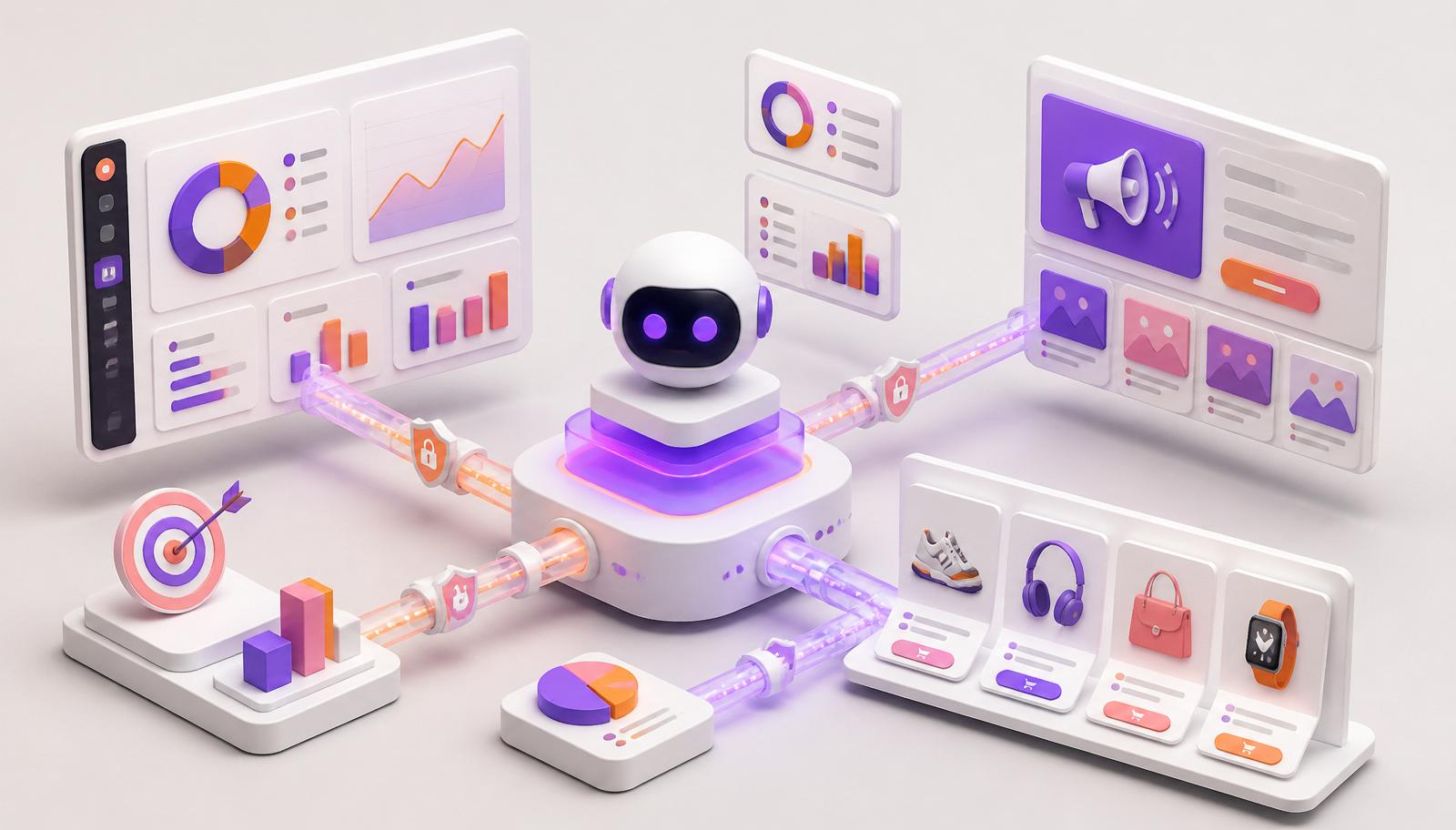 AI MarketingJuly 22, 20269 min
Meta’s Hierarchical Interest Representation: What Meta’s New Ads Layer Means for Your Deep-Funnel Performance
Meta just introduced Hierarchical Interest Representation — a new upstream layer for its ads stack built for deep-funnel optimization, sparse signals, and generative ranking models like GEM and Andromeda. Here is what it actually does and how to reshape your Meta Ads strategy around it in 2026.
Read article AI MarketingMay 15, 202612 min
AI Search 2026: The CMO Guide to AI Overviews, ChatGPT Search & Perplexity
AI Overviews, ChatGPT Search and Perplexity are reshaping search. What CMOs need to know about zero-click, grounding and AI visibility — including a measurement framework and immediate actions.
Read article
Bekomme solche Insights jede Woche.
Strategische Marketing-Insights für CMOs — kein Fluff, kein Spam.