
Meta’s Hierarchical Interest Representation: What Meta’s New Ads Layer Means for Your Deep-Funnel Performance
just introduced Hierarchical Interest Representation — a new upstream layer for its ads stack built for deep- optimization, sparse signals, and generative ranking models like GEM and Andromeda. Here is what it actually does and how to reshape your Meta Ads strategy around it in 2026.
Why this update is more than a research paper
Meta’s engineering team just published a new building block of its ads stack: Hierarchical Interest Representation (HIR). It reads like research — but it is the layer that GEM, Andromeda, and the Adaptive Ranking Model will increasingly rely on to decide who sees which deep- . For CMOs and performance leads, that means the logic behind audiences, signals, and creative is shifting — and with it, what actually scales on in 2026.
What Hierarchical Interest Representation actually is
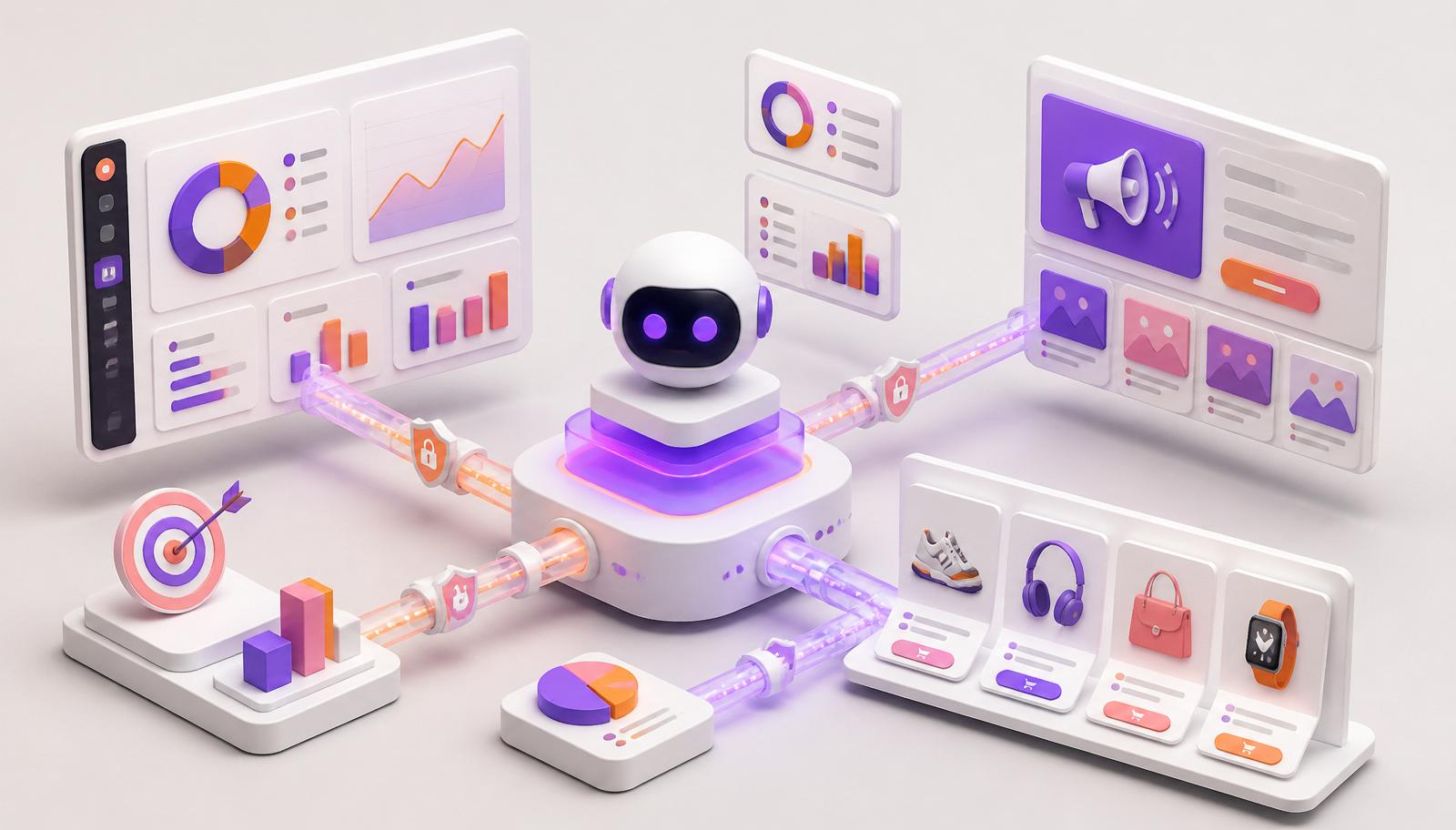
HIR is an upstream layer that models users, advertisers, products, services, and campaigns as one large typed graph. On top of that graph, a -based model learns unified — shared vector spaces in which people and offers can understand each other.
Four core ideas:
- Dimension reduction: The raw graph is compressed into a super-graph. Sparse deep- signals (purchases, leads, sign-ups) get bundled into dense "interest primitives".
- Knowledge enrichment: Multimodal content (text, image, video) from advertiser pages and product catalogs is processed through LLMs. Meta then understands what an offer is, not just how often it gets clicked.
- Unified relational representation: Users, ads, brands, and products live in the same vector space, enabling similarity and affinity queries across all entity types.
- Multi-hierarchical granularities: Interests are represented at multiple levels — from stable, high-level anchors down to specific niche signals.
Meta also discretizes the embeddings into Bag-of-Meaning (BoM) tokens — a compact vocabulary of interest concepts that can be reused for retrieval, personalization, and ranking.
The real problem this solves
Deep- events are rare. Millions of advertisers compete for billions of users, but purchases, qualified leads, and CRM events remain structurally sparse. Classic ranking models hit a wall here: too little signal, too much noise, poor generalization to new advertisers and new products.
HIR tackles three hard problems at once:
- Signal scarcity in the deep — via self-supervised learning and cross-view distillation, the model learns from users who have never converted.
- Cold start for new advertisers and SKUs — multimodal features let Meta understand advertisers without long performance histories.
- Long-range relationships — FlexAttention and bias-aware attention connect entities that are far apart in the graph but semantically related.
What this concretely means for your 2026 Meta Ads strategy
keeps moving away from a click- and -driven auction model toward an interest- and semantics-driven recommendation system. Your levers shift accordingly.
- Content supply beats targeting . If Meta derives audiences from embeddings, the winners are advertisers who supply many differentiated, semantically rich creatives. A creative operating stack is no longer a nice-to-have — it is a precondition.
- Product and brand data become ranking signals. Catalog quality, attributes, images, videos, and landing-page semantics flow into targeting via LLM enrichment. Neglected catalogs will cost you reach directly.
- Deep-funnel events must be clean and complete. Server-side tracking via the Conversions API, CRM events, offline conversions, and value-based signals are the fuel HIR runs on. Messy measurement gets punished harder in the new system.
- Broad targeting becomes the default. Interest segments keep losing relevance. Your levers are creative, offer, signal quality, and bidding — not detailed audience trees.
- New advertisers and new SKUs ramp faster — provided your content and catalog infrastructure is solid.
A 90-day plan for performance and brand teams
A pragmatic roadmap for aligning your setup with an HIR-driven :
- Weeks 1–3: Signal audit. Conversions API coverage, event match quality, value-based events, CRM and offline import. Target: EMQ ≥ 8 on all deep- events.
- Weeks 3–6: Catalog and enrichment. Product feeds with clean attributes, images, video, categories. Advertiser page and landing pages entity-optimized (brand, product, benefit, proof).
- Weeks 4–8: Creative operating stack. Modular creative templates, AI-driven variant generation, clear approval flows. Target: 30–100 on-brand variants per campaign instead of 3–5.
- Weeks 6–10: Campaign consolidation. Merge fragmented ad sets, roll out Advantage+ with guardrails, define clear value rules for bidding.
- Weeks 8–12: Measurement. Bring MMM, incrementality testing, and attribution together. Deep-funnel KPIs per SKU, market, and segment — weekly cadence instead of quarterly reports.
What this means for brands that treat Meta as reach only
HIR further blurs the line between brand and performance on . Because the model learns stable interest anchors, consistent brand messaging and recognizable creative systems pay in directly on deep- efficiency. Brands that run only discount ads in 2026 lose twice: weaker signals in HIR and weaker anchors in the interest primitives.
Takeaway
Hierarchical Interest Representation is not a feature update — it is the next step in Meta’s rebuild toward a fully AI-orchestrated recommendation system. Winning in 2026 means moving budget out of manual targeting and into signal quality, catalog and infrastructure, and industrialized creative — and treating brand coherence as a performance lever, not a separate budget line.
FAQ
Do I need to change anything in Ads Manager?
No. HIR is an internal layer. Your optimization sits in signal quality, catalog, creative, and structure.
Are interest targetings going away?
Not formally, but their relevance keeps declining. Broad + strong signals + strong creative beats narrow interest trees in most deep- setups.
How fast does HIR take effect?
Meta rolls out layers like this gradually across GEM, Andromeda, and the Adaptive Ranking Model. Expect effects in several waves through 2026 — advertisers who prepare early benefit first.
Loading related terms…
All TermsReady for your next project?
Let's discuss your marketing challenges and develop solutions together.
Get in touchKeep reading
Related posts
 AI MarketingJuly 27, 20268 min
ChatGPT Ads: Conversion Bidding, Measurement and What to Prepare Now
Advertising inside assistant interfaces is becoming measurable and biddable. We break down how conversion bidding in chat environments differs from search and social — and how to prepare measurement, creative and governance.
Read article AI MarketingMay 20, 202611 min
AI-Driven Branding for FMCG: How CMOs Combine AI Precision and Creative Excellence for Scalable Brand Growth
FMCG and CPG brands are squeezed between retail pressure, fragmented audiences, and exploding content demand. This playbook shows how to combine AI with creative brand leadership — from insight to design to campaign — and turn it into a scalable growth engine.
Read article AI MarketingMay 15, 202612 min
AI Search 2026: The CMO Guide to AI Overviews, ChatGPT Search & Perplexity
AI Overviews, ChatGPT Search and Perplexity are reshaping search. What CMOs need to know about zero-click, grounding and AI visibility — including a measurement framework and immediate actions.
Read article
Bekomme solche Insights jede Woche.
Strategische Marketing-Insights für CMOs — kein Fluff, kein Spam.