
AI Lead Scoring: How Machine Learning Transforms Your Sales
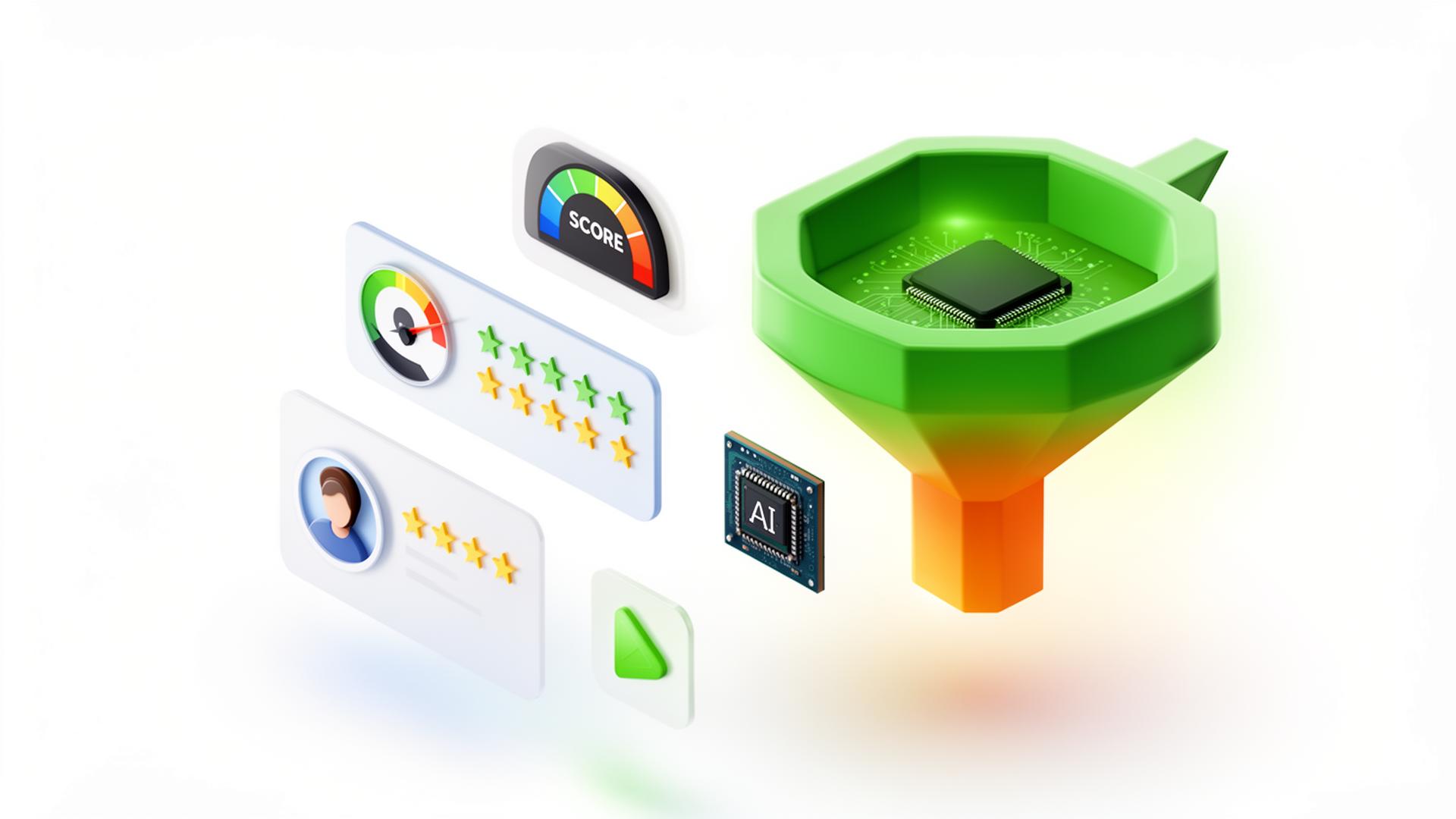
Traditional is dead. Learn how AI-powered scoring with firmographics, behavioral data, and intent signals triples rates and shows your sales team where effort truly pays off.
AI Lead Scoring: Why Rule-Based Scoring Is Obsolete
Every B2B company knows the problem: Marketing generates hundreds of leads, but sales complains about quality. The pipeline is full, but rates stagnate. The reason: Traditional fails in an increasingly complex world.
Rule-based scoring, "+10 points for whitepaper download, +20 for pricing page", was the standard in the 2010s. Today it's a relic. uses machine learning to calculate predictive scores from hundreds of signals that forecast actual purchase decisions.
What Is AI Lead Scoring?
uses machine learning to automatically evaluate leads and accounts by their probability. Instead of manually defined rules, ML models analyze historical conversion data and identify patterns that humans simply wouldn't recognize.
Rule-Based vs. AI-Based: The Difference
| Dimension | Rule-Based Scoring | AI Lead Scoring |
|---|---|---|
| Foundation | Manually defined rules | Machine learning models |
| Signals | 5–15 criteria | 100+ variables |
| Updates | Quarterly reviews | Real-time updates |
| Bias | Team assumptions | Data-driven |
| Accuracy | 20–30% | 60–80% hit rate |
| Scaling | Linear (more rules = more chaos) | Exponential (more data = better) |
The fundamental difference: Rule-based scoring asks "What do we believe is important?" AI scoring asks "What do the data show actually leads to deals?"
The Architecture of an AI Scoring Model
A modern system processes four signal categories:
1. Firmographic Signals (Fit)
- Company size and revenue
- Industry and sub-industry
- Technology stack (via technographic data)
- Growth rate and funding status
- Geographic presence
2. Engagement Signals (Interest)
- Website behavior: Pages visited, time on site, return frequency
- Email interactions: Open rate, click rate, reply rate
- consumption: Downloads, video views, attendance
- Social engagement: LinkedIn interactions, social shares
3. Intent Signals (Purchase Intent)
- Third-party research behavior on relevant topics
- Competitor evaluations
- Industry-specific keyword research
- Intent surges (anomalous activity spikes)
4. Timing Signals (Urgency)
- Speed of activity increase
- Budget cycles and fiscal year ends
- Contract expiration dates for existing solutions
- Personnel changes in the buying committee
The Sandwich Approach: AI Analyzes, Humans Decide
The most successful teams in 2026 use the Sandwich Model for :
Layer 1 (Human): Define strategy, Which signals are relevant for our business? Which segments do we prioritize?
Layer 2 (AI): Execute analysis, Machine learning models process hundreds of data points, recognize patterns, and calculate predictive scores.
Layer 3 (Human): Make decisions, Sales professionals interpret scores in context, validate prioritization, and conduct contextual outreach.
Why this approach? Purely AI-driven systems fail at contextual knowledge not encoded in data: relationships, political dynamics within accounts, strategic considerations. Purely human evaluations fail at scale and bias. The Sandwich Approach combines the best of both worlds.
Propensity-to-Buy Models: The Next Level
Advanced goes beyond simple scores to specifically forecast close probability:
How a Propensity Model Works
1. Training: The ML model analyzes all deals from the past 2–3 years, won and lost.
2. Pattern Recognition: It identifies which combinations of signals historically led to closed deals.
3. Scoring: New leads are evaluated against these patterns and receive a percentage close probability.
4. Feedback Loop: Every new win or loss continuously refines the model.
Example: What the Model Discovers
A propensity model for an enterprise SaaS company might identify:
- Accounts with 100–500 employees and SaaS tech stacks have a 3x higher
- The combination of pricing page visit + 2nd demo request + CFO involvement yields 78% close probability
- Leads that take a second action within 48 hours of their first download convert 4x more often
- Accounts in growth phase (Series B/C) show 60% faster sales cycles
These patterns would be impossible to spot manually, they emerge from analyzing thousands of historical data points.
Dynamic Re-Scoring: Living Scores
A static score is worthless. updates evaluations in real time as new signals arrive:
Scenario 1: The Sleeping Lead Awakens
A was inactive for 30 days (Score: 25/100). Suddenly they read 3 case studies, visit the pricing page, and register for a . New score: 82/100. The SDR receives an immediate alert with full activity context.
Scenario 2: The Hot Lead Cools Down
An account had Score 90/100 after a demo. Two weeks of silence, no email opens, no website visits. The score drops to 55/100. The system suggests a re-engagement campaign.
Scenario 3: Buying Committee Grows
Previously only one person from the account interacted. Suddenly three additional employees visit the website, a VP Sales, an IT Lead, and a Procurement Manager. Multi-threading signal: The buying process is getting serious.
Implementation: From Zero to AI Lead Scoring
Check Prerequisites
Before implementing , verify:
- Data quality: At least 12 months of clean CRM data with clear won/lost
- Data volume: At least 200–500 closed deals for meaningful model training
- Tracking infrastructure: Website analytics, email tracking, and content must be captured
- Team buy-in: Sales and marketing must jointly support the scoring approach
4-Phase Implementation
Phase 1: Data Audit & Preparation (2–4 weeks)
- Ensure CRM data quality
- Analyze and label historical deals
- Identify and connect data sources
- Document baseline metrics
Phase 2: Model Development (4–6 weeks)
- Define features (which signals feed in?)
- Split training and test data (70/30)
- Train and validate models
- Define scoring thresholds for MQL/SQL/SAL
Phase 3: Pilot & Testing (4 weeks)
- Parallel operation: AI score vs. existing scoring
- A/B test: SDR team prioritizes by AI score vs. manually
- Establish feedback loops with the sales team
- Score calibration based on initial results
Phase 4: Scale & Optimize (ongoing)
- Roll out AI scoring for the entire sales team
- Implement automated workflows (alerts, routing)
- Monthly model monitoring and re-training
- Closed-loop reporting: Score → Pipeline → Revenue
Common AI Lead Scoring Mistakes
1. Ignoring Data Bias
If your historical dataset primarily contains deals from one industry, the model will favor that industry, even if others are equally relevant. Solution: Diverse training data and regular bias audits.
2. Overfitting to Past Patterns
A model that perfectly fits historical data fails in new market situations. Solution: Cross-validation and regular re-training with current data.
3. Black-Box Scores Without Context
A score of "87" without explanation doesn't build trust with the sales team. Solution: Explainable AI, show the top 3 factors driving the score.
4. Not Involving the Sales Team
AI without sales buy-in is worthless. Solution: Include sales reps in feature definition and testing.
ROI of AI Lead Scoring
Companies implementing report:
- : +200–300% vs. rule-based scoring
- Sales cycle: 25–40% shorter through better prioritization
- Sales productivity: +40% by focusing on high-propensity accounts
- Forecast accuracy: +35% through data-supported pipeline evaluation
- Marketing ROI: +50% through more targeted campaigns
Conclusion: Scoring as Competitive Advantage
isn't simply a better point system, it's a fundamental shift in how marketing and sales collaborate. Instead of subjective evaluations and gut feelings, prioritization decisions are based on predictive models that continuously improve.
The Sandwich Approach shows the way: AI delivers data analysis and pattern recognition. Humans deliver strategy, context, and relationship building. Together, a sales process emerges that's not just more efficient but delivers measurably better results.
The question is no longer whether you need , but how quickly you implement it before your competition does.
Loading related terms…
All TermsReady for your next project?
Let's discuss your marketing challenges and develop solutions together.
Get in touchKeep reading
Related posts
 AIAugust 30, 20269 min
Grok Bot Skills: How to Truly Scale AI in Your Marketing
Reusable task instructions help teams organise AI work consistently. Learn how to connect briefs, data, quality checks and version control, and measure the benefits in your own workflow.
Read article AIAugust 30, 20269 min
AI with Brand DNA: Why Generic Bots Are a Brand Risk
Off-the-shelf AI assistants can dilute your brand. Learn how strategic calibration, guardrails, and red-teaming can transform a generic bot into a powerful, on-brand ambassador that positively impacts business outcomes.
Read article AIAugust 30, 20269 min
Prompt Ops: The Operating System for AI in Marketing
The uncontrolled use of AI prompts leads to chaos. Prompt Ops provides a structured approach to manage prompts like software, ensuring efficiency, quality, and scalability in marketing.
Read article
Bekomme solche Insights jede Woche.
Strategische Marketing-Insights für CMOs — kein Fluff, kein Spam.