
From Figma token to CMS: how design systems prevent brand inconsistency
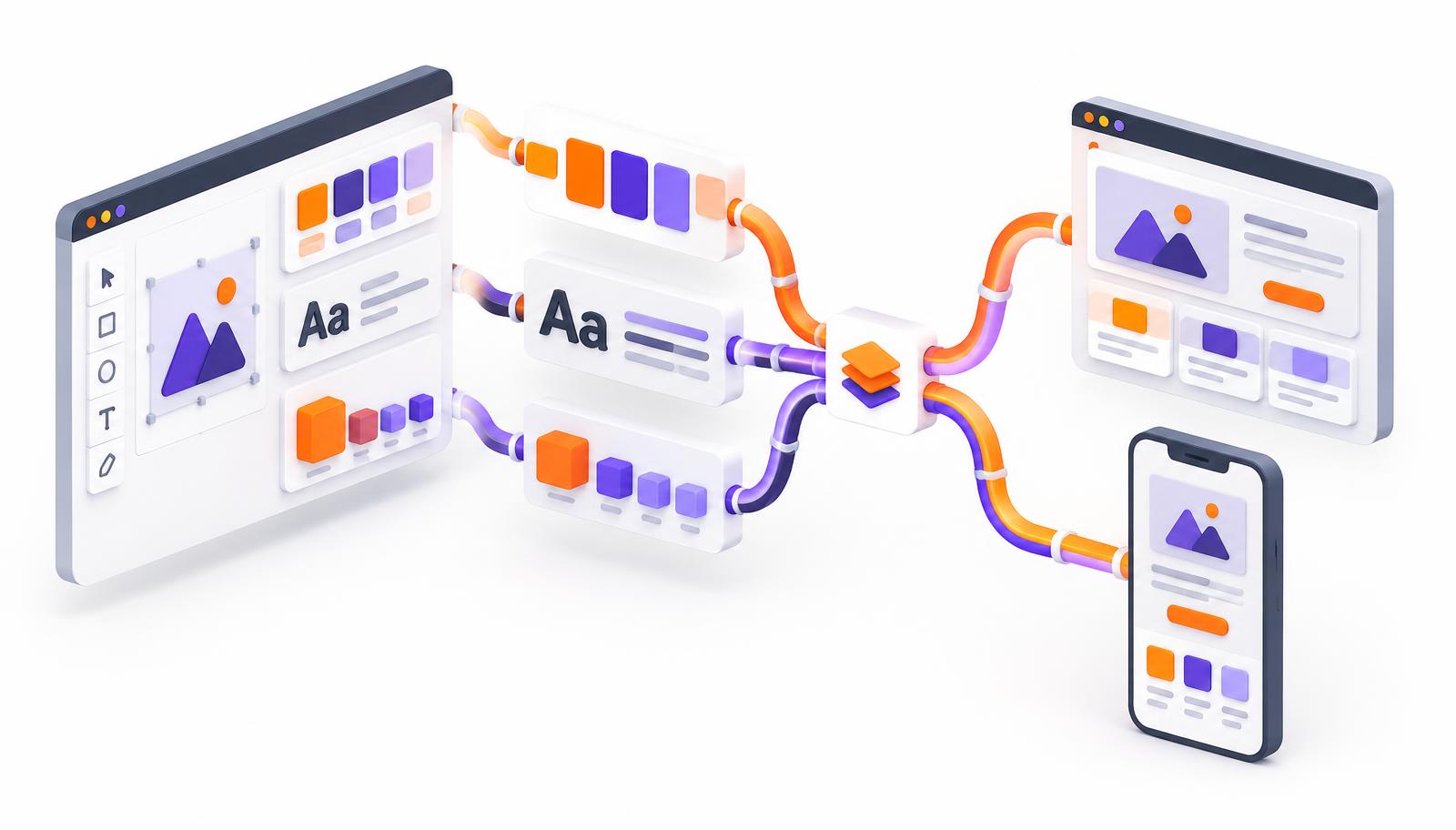
What are, what the stable 2025.10 format changes and how brands carry colours, typography and spacing consistently from design into website, app and .
The problem: the brand falls apart between tools
In many companies the brand lives in several places at once: a PDF style guide, design files, website code, the app and templates. Every change, whether an adjusted orange, a new font size or a dark mode, has to be repeated manually in each place. That slows approval loops and creates visible inconsistencies. For brand leaders this is not just aesthetics: inconsistency slows campaigns and makes every extension more expensive.
Design tokens as a shared language
Design tokens store design decisions such as colours, typography, spacing or shadows as named, platform-independent values. Instead of “#FF6B00” in many places, the system uses a name like “brand colour primary”. Tools then translate that value automatically into the formats your website, app or templates require.
On 28 October 2025, the W3C Group published the first stable version of its exchange format (Design Tokens Format Module 2025.10). The specification is explicitly not an official W3C standard, but it is described as stable and intended for implementation. According to the announcement, it supports theming for multiple brands and modes, modern colour spaces and references between tokens. For companies, a vendor-neutral format reduces dependency on individual tools.
The path from design to CMS
A robust setup has three layers. Base values describe the available palette. Semantic tokens describe meaning, such as “background”, “text” or “action”. Component tokens define how a button or card uses those meanings. When a brand colour changes, one value is updated and every channel picks it up through automated processing.
In the CMS this pays off when editors work with approved components rather than freely formatted areas. Landing pages, product pages and modules stay on brand without each page needing individual review.
Where design tokens create business value
- Faster time to market: new pages and campaigns are built from tested building blocks.
- Multi-brand capability: sub-brands or country sites use the same components with their own theme.
- Accessibility: contrast and font sizes are checked once and used everywhere, which also helps with Germany's Accessibility Strengthening Act.
- Safer relaunches: during a website relaunch, design and structure can evolve independently.
Important: tokens do not replace brand strategy or a design team. They make decisions you have already made reproducible.
Our approach
We start with an audit of existing colours, fonts and components, define a structure and connect it to design files and code. Learn more about colour systems and layouts. Talk to us if your brand is drifting apart across channels.
Frequently asked questions
- Do replace a design system? No. Tokens store reusable design values. A design system also includes components, interaction behaviour, rules, documentation and ownership.
- Is the 2025.10 format an official W3C standard? No. It is the stable specification of the Community Group, not a W3C Recommendation. Check support in your actual tools before adopting it.
- Does exporting tokens from Figma automatically make a CMS on-brand? No. The export must be translated into tested website components. Editorial permissions, permitted variants and tests determine whether the CMS stays consistent with the brand.
- Do design tokens guarantee accessibility? No. Tokens support consistent colours and spacing. Contrast in actual combinations, keyboard operation, focus management, semantics and understandable content still need separate checks.
Sources
Loading related terms…
All TermsReady for your next project?
Let's discuss your marketing challenges and develop solutions together.
Get in touchKeep reading
Related posts
 Digital TrendsNovember 13, 20269 min
Website relaunch without losing search visibility: a roadmap for marketing leaders
How to plan a relaunch or platform migration without risking visibility, enquiries and revenue: inventory, redirect mapping, testing and monitoring.
Read article Digital TrendsNovember 13, 20269 min
Withdrawal button and accessibility law: new e-commerce duties without hurting conversion
Germany's withdrawal button (§ 356a BGB) applies from 19 June 2026 and the BFSG accessibility law from 28 June 2025. What this means for shop UX, processes and trust. Not legal advice.
Read article Digital TrendsSeptember 13, 20266 min
Payload & MCP: From product knowledge to reviewed content
The product knowledge exists, but publishing the next page still takes many manual steps. A practical example shows how a CMS, AI and editors can work together.
Read article
Bekomme solche Insights jede Woche.
Strategische Marketing-Insights für CMOs — kein Fluff, kein Spam.