
Demand Generation
Demand Generation explained
Start with an decision: which problem is being overlooked, which alternative needs explanation and when does a solution become relevant? A good story makes that situation understandable. It connects a recognisable occasion with a useful perspective and a credible offer. alone does not show whether that connection succeeded.
Demand generation can reach people who are not yet searching for a supplier and help interested people assess their options. Lead generation then creates identifiable contact for further handling. Both tasks can occur within one programme. A form does not automatically make content poor, and a freely accessible podcast does not automatically produce qualified demand.
Plan content around real questions and available evidence. An expert article can compare approaches, a demonstration can show limitations, and a customer project can explain a documented implementation. Choose distribution and a next step that fit the context. Useful content may also reveal that the offer is unsuitable for the particular task.
Agree with sales and service how relevant enquiries are recognised and answered. Evaluate awareness, use of information and confirmed opportunities separately. Brand searches and self-reported contact sources offer clues, not a complete account of effectiveness. “Sourced” and “influenced pipeline” can overlap and must not simply be added together.
Examples
Hypothetical application
An industrial-maintenance provider publishes articles explaining how businesses can compare maintenance approaches. An openly accessible question guide helps with preparation. People wanting to discuss a specific installation can request a conversation. The team later checks which needs were suitable and which information was missing.
Key Points
- Connect a relevant problem with a credible offer clearly.
- Coordinate demand development with capturing an identifiable contact.
- Assess attention, opportunities and additional effects separately.
Practical application
Choose an important customer question and develop a well-founded story supported by appropriate evidence. Plan the path from the first encounter to an answered enquiry. Use feedback from actual conversations to sharpen and offer.
Useful measures
Relevant understanding
Use suitable feedback or research to check whether people understand the problem and offer.
Suitable enquiries
Assess needs and further handling against shared criteria.
Comparable cohorts over time
Follow opportunities, sales and complete costs over an appropriate period.
Common mistakes
- Promising universal CAC reductions, close rates or fixed effect timelines.
- Dismissing forms and MQLs altogether or treating them as the sole proof of success.
- Double-counting sourced and influenced opportunities as additional revenue.
Sources and context
- Salesforce: Demand generation
Scope of the relationship between awareness, interest and qualified demand.
- HubSpot: Inbound Marketing
Principle of useful content and HubSpot’s stage model.
- HubSpot: Lifecycle stages
Customisable stages and distinctions between leads, qualification and opportunities in HubSpot’s model.
Frequently Asked Questions about Demand Generation
It depends on awareness, offer, decision time and distribution. Define useful intermediate goals and observation periods instead of promising universal timelines or a fixed ROI.
No. Access should fit the task and be clearly explained. Public guidance, registered events and individual consultations can complement one another.
There is no universal percentage. Check whether the gap is awareness, understandable information, accessible offers or subsequent handling. Budget for that specific task.
Loading related terms…
All TermsArticles about Demand Generation

Agentic Marketing: How Autonomous AI Agents Are Transforming Marketing in 2026
Autonomous agents take over research, campaign ops and real-time budget allocation. What agentic marketing means for CMOs, which use cases work today, and how to set up governance and ROI.
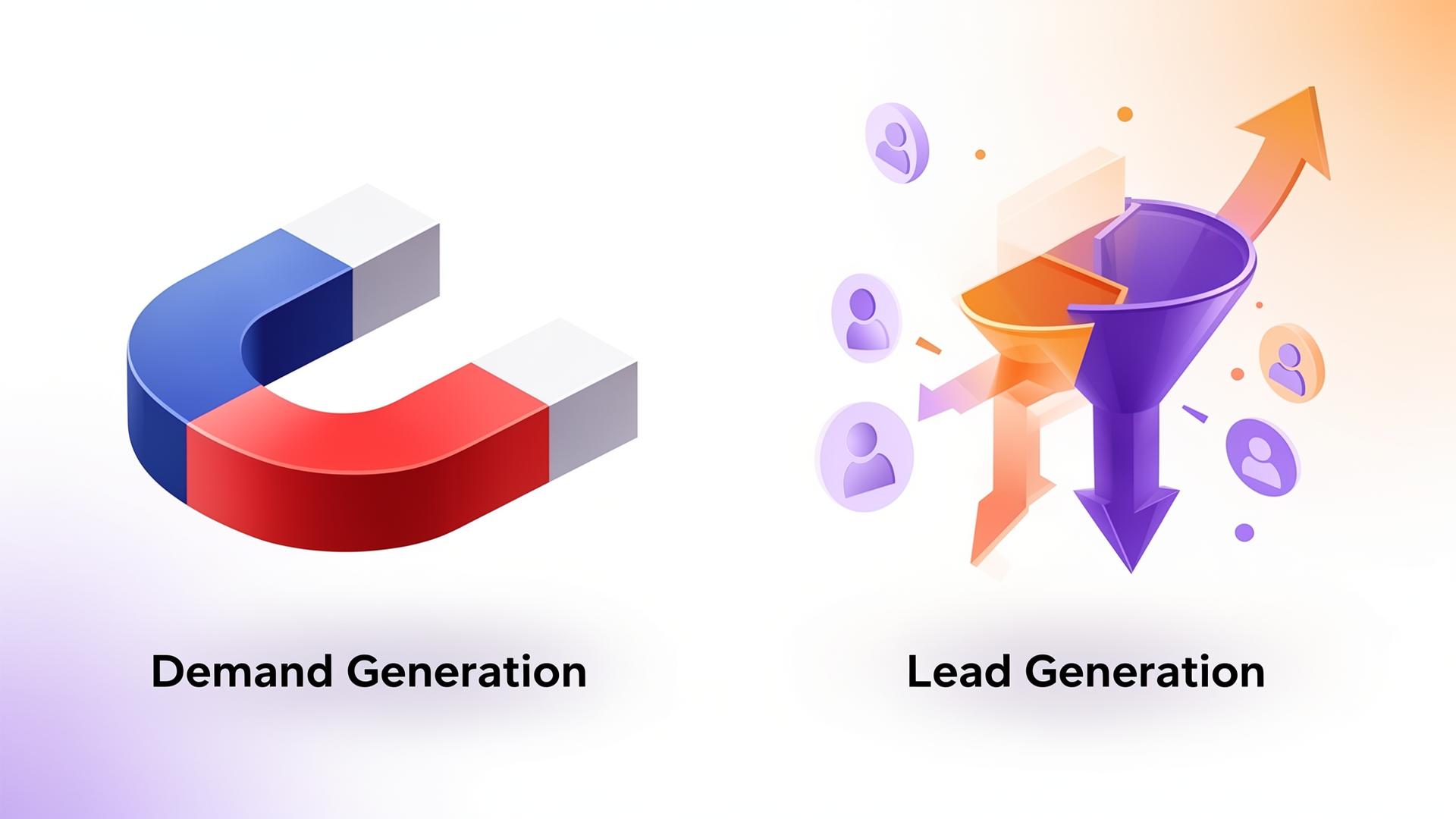
Demand Generation vs. Lead Generation: Why You Need Both,But Not the Way You Think
Demand Generation and Lead Generation are often confused or pitted against each other. Learn why the future lies in integrated revenue marketing and how to strategically interlock both disciplines.

Prompt Ops: The Operating System for AI in Marketing
The uncontrolled use of AI prompts leads to chaos. Prompt Ops provides a structured approach to manage prompts like software, ensuring efficiency, quality, and scalability in marketing.